
Addressing the STEM Educators Workforce Shortage
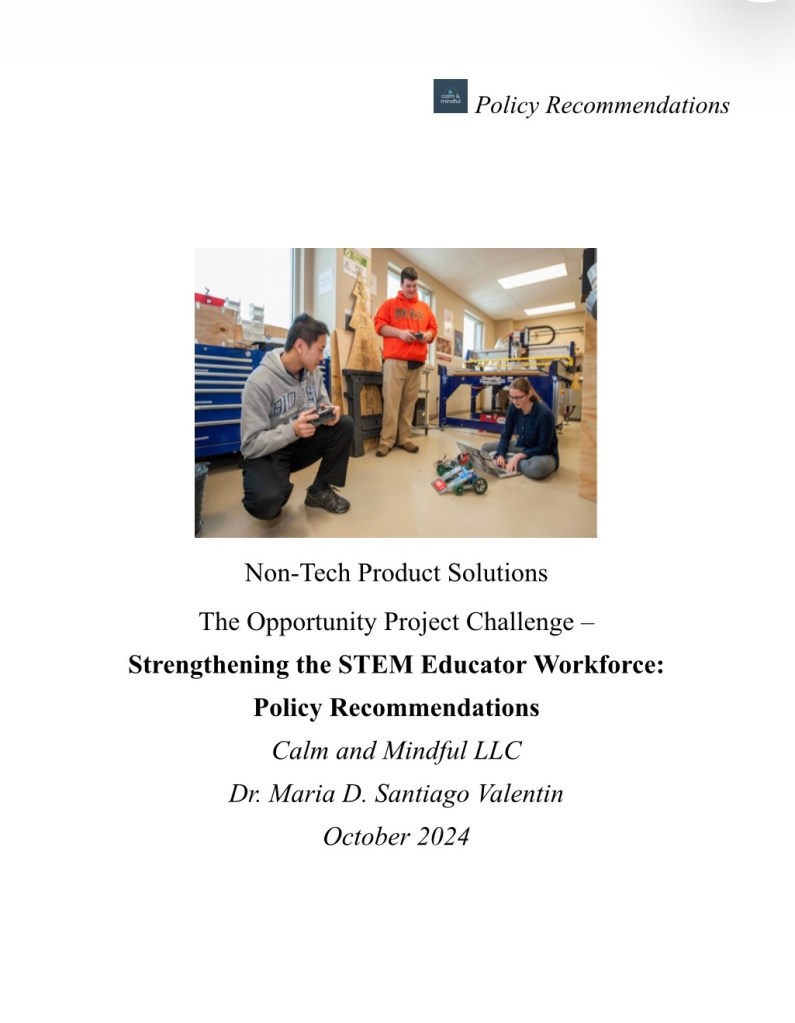
We’re excited to announce the publication of our 2024 research, The Opportunity Project Challenge – Strengthening the STEM Educator Workforce: Policy Recommendations, authored by Dr. Maria D. Santiago Valentin and now publicly available through Zenodo.
📄 Read the full paper: https://doi.org/10.5281/zenodo.22016935
Why This Matters
The United States is facing a STEM educator shortage that shows no signs of slowing down. During the 2017–2018 school year alone, nearly 100,000 STEM teaching positions went unfilled at the high school level, and close to 150,000 went unfilled at the middle school level. These aren’t just numbers on a page — they represent classrooms without qualified instruction in the subjects our students need most to compete in a rapidly changing world.
Part of the problem comes down to money. STEM professionals who choose to teach often take a pay cut of roughly $40,000 compared to what they could earn elsewhere in their field — a gap researchers call the “wage penalty.” When the private sector consistently outbids the classroom, it’s no surprise that talented STEM minds look elsewhere, and that the teachers who do enter the profession often don’t stay long. Many novice STEM teachers leave the classroom before their fifth year.
This shortage doesn’t affect all students equally. It deepens existing inequities, particularly for students in under-resourced schools who are already less likely to have access to qualified STEM instruction — a gap that contributes to the ongoing underrepresentation of minorities and women in STEM careers.
How We Approached the Problem
Rather than relying solely on existing literature, we wanted to understand what STEM educators themselves were experiencing. Our research combined:
- Semi-structured interviews with STEM educators, analyzed manually using NVivo coding to identify patterns across two analytical cycles
- A review of current STEM legislation across all 50 states and at the federal level
- An extensive literature review examining the challenges facing the STEM educator workforce
This mixed approach let us ground our recommendations not just in what researchers have found, but in what teachers are actually living through in classrooms across the country.
Three Areas for Policy Change
The paper organizes its recommendations around three interconnected areas:
1. Enhancing Teacher Training Programs
Effective preparation is one of the strongest predictors of whether a teacher stays in the profession. Our recommendations call for collaboration between universities, state departments of education, and industry to build comprehensive, equitable national STEM standards — including training in social-emotional learning, classroom management, and support for diverse and special-needs populations. We also recommend formalizing mentorship as a required, well-supported position for novice STEM teachers, rather than treating it as an informal extra duty.
2. Increasing Financial Incentives for STEM Educators
Competitive compensation isn’t just about fairness — it’s about supply. The paper recommends higher salaries, student loan forgiveness programs, and portable pension structures that let teachers move between districts and states without losing retirement benefits. We also highlight promising models like endowed chairs for STEM positions in school districts, which can help offset salary and benefits costs at the district level.
3. Supporting Ongoing Professional Development
STEM fields evolve quickly, and teachers need sustained support to keep pace. Recommendations here include funded mentorship curricula, a proposed national STEM certification that would make it easier for teachers to relocate between states, and support for attending professional conferences like those hosted by ISTE (International Society for Technology in Education) and ASCD (Association for Supervision and Curriculum Development).
Part of a Two-Part Solution
This policy paper is one of two solutions Calm and Mindful, LLC developed in response to the national STEM educator shortage. Alongside it, we built a complementary technical solution: an eight-module online training program designed to give novice STEM teachers practical, hands-on support during their earliest — and often most vulnerable — years in the classroom.
Together, the two products pair immediate, teacher-facing support with the kind of systemic policy change needed to make that support sustainable over the long term.
Presented to Federal Decision-Makers
Both solutions were developed as part of The Opportunity Project, a rapid-prototyping model led in collaboration with the U.S. Census Bureau, which brings together organizations to turn public data into usable solutions for national challenges. Our work was presented directly to the U.S. Department of Education and the U.S. Census Bureau — giving these recommendations a direct line to the people positioned to act on them.
Read the Full Paper
We’re grateful to every educator who shared their time and experience to make this research possible. We hope these recommendations serve as a useful, evidence-informed resource for policymakers, district leaders, and anyone working to build a stronger, more sustainable STEM educator workforce.
📄 The full paper is available now at: https://doi.org/10.5281/zenodo.22016935
Citation: Santiago-Valentin, M. & Calm and Mindful LLC. (2026). The Opportunity Project Challenge – Strengthening the STEM Educator Workforce: Policy Recommendations. Zenodo. https://doi.org/10.5281/zenodo.22016935
 Calm and Mindful, LLC