Strengthening the STEM Educator Workforce: Our New Policy Recommendations Paper Is Here

Addressing the STEM Educators Workforce Shortage

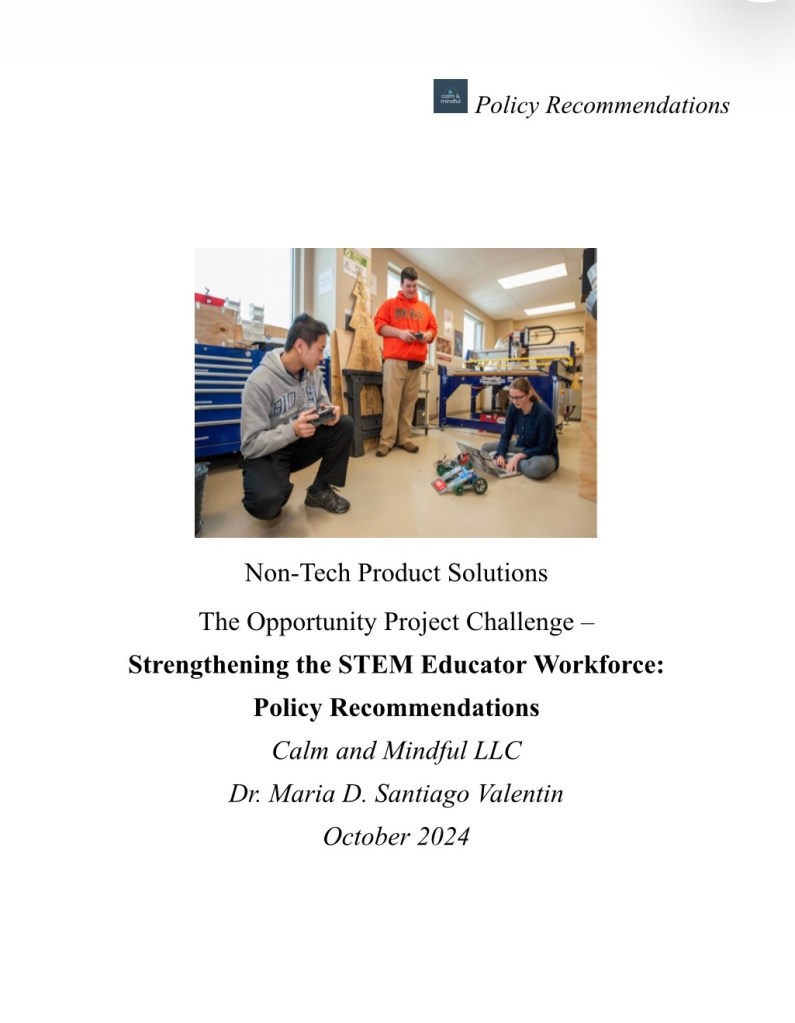
We’re excited to announce the publication of our 2024 research, The Opportunity Project Challenge – Strengthening the STEM Educator Workforce: Policy Recommendations, authored by Dr. Maria D. Santiago Valentin and now publicly available through Zenodo.

📄 Read the full paper: https://doi.org/10.5281/zenodo.22016935

Why This Matters

The United States is facing a STEM educator shortage that shows no signs of slowing down. During the 2017–2018 school year alone, nearly 100,000 STEM teaching positions went unfilled at the high school level, and close to 150,000 went unfilled at the middle school level. These aren’t just numbers on a page — they represent classrooms without qualified instruction in the subjects our students need most to compete in a rapidly changing world.

Part of the problem comes down to money. STEM professionals who choose to teach often take a pay cut of roughly $40,000 compared to what they could earn elsewhere in their field — a gap researchers call the “wage penalty.” When the private sector consistently outbids the classroom, it’s no surprise that talented STEM minds look elsewhere, and that the teachers who do enter the profession often don’t stay long. Many novice STEM teachers leave the classroom before their fifth year.

This shortage doesn’t affect all students equally. It deepens existing inequities, particularly for students in under-resourced schools who are already less likely to have access to qualified STEM instruction — a gap that contributes to the ongoing underrepresentation of minorities and women in STEM careers.

How We Approached the Problem

Rather than relying solely on existing literature, we wanted to understand what STEM educators themselves were experiencing. Our research combined:

  • Semi-structured interviews with STEM educators, analyzed manually using NVivo coding to identify patterns across two analytical cycles
  • A review of current STEM legislation across all 50 states and at the federal level
  • An extensive literature review examining the challenges facing the STEM educator workforce

This mixed approach let us ground our recommendations not just in what researchers have found, but in what teachers are actually living through in classrooms across the country.

Three Areas for Policy Change

The paper organizes its recommendations around three interconnected areas:

1. Enhancing Teacher Training Programs

Effective preparation is one of the strongest predictors of whether a teacher stays in the profession. Our recommendations call for collaboration between universities, state departments of education, and industry to build comprehensive, equitable national STEM standards — including training in social-emotional learning, classroom management, and support for diverse and special-needs populations. We also recommend formalizing mentorship as a required, well-supported position for novice STEM teachers, rather than treating it as an informal extra duty.

2. Increasing Financial Incentives for STEM Educators

Competitive compensation isn’t just about fairness — it’s about supply. The paper recommends higher salaries, student loan forgiveness programs, and portable pension structures that let teachers move between districts and states without losing retirement benefits. We also highlight promising models like endowed chairs for STEM positions in school districts, which can help offset salary and benefits costs at the district level.

3. Supporting Ongoing Professional Development

STEM fields evolve quickly, and teachers need sustained support to keep pace. Recommendations here include funded mentorship curricula, a proposed national STEM certification that would make it easier for teachers to relocate between states, and support for attending professional conferences like those hosted by ISTE (International Society for Technology in Education) and ASCD (Association for Supervision and Curriculum Development).

Part of a Two-Part Solution

This policy paper is one of two solutions Calm and Mindful, LLC developed in response to the national STEM educator shortage. Alongside it, we built a complementary technical solution: an eight-module online training program designed to give novice STEM teachers practical, hands-on support during their earliest — and often most vulnerable — years in the classroom.

Together, the two products pair immediate, teacher-facing support with the kind of systemic policy change needed to make that support sustainable over the long term.

Presented to Federal Decision-Makers

Both solutions were developed as part of The Opportunity Project, a rapid-prototyping model led in collaboration with the U.S. Census Bureau, which brings together organizations to turn public data into usable solutions for national challenges. Our work was presented directly to the U.S. Department of Education and the U.S. Census Bureau — giving these recommendations a direct line to the people positioned to act on them.

Read the Full Paper

We’re grateful to every educator who shared their time and experience to make this research possible. We hope these recommendations serve as a useful, evidence-informed resource for policymakers, district leaders, and anyone working to build a stronger, more sustainable STEM educator workforce.

📄 The full paper is available now at: https://doi.org/10.5281/zenodo.22016935

Citation: Santiago-Valentin, M. & Calm and Mindful LLC. (2026). The Opportunity Project Challenge – Strengthening the STEM Educator Workforce: Policy Recommendations. Zenodo. https://doi.org/10.5281/zenodo.22016935

Screenshot

Our Forte: Qualitative Methods Inquiry


Calm and Mindful LLC: Researching with Purpose to Strengthen Education

In 2024, Calm and Mindful LLC embarked on a transformative research initiative that addressed one of the most pressing challenges in American education: the nationwide STEM educator workforce shortage. Guided by a qualitative methodology rooted in empathy, collaboration, and data-informed reflection, the organization examined not only the structural gaps behind this shortage but also the lived experiences of educators navigating increasingly complex classroom demands.

The research team at Calm and Mindful LLC believed that understanding human stories was essential to uncovering sustainable solutions. Through in-depth interviews, focus groups, and case studies across diverse school districts in neighboring states, they uncovered patterns of burnout, inequitable access to professional development, and insufficient integration between mental health support and instructional expectations. Rather than viewing these themes as barriers, the study framed them as opportunities for systemic renewal and educator empowerment.

This qualitative inquiry inspired an action model that bridged educational leadership, mindfulness practices, and workforce sustainability. By incorporating educator wellness and social-emotional learning into recruitment and retention frameworks, Calm and Mindful LLC positioned wellbeing as both an ethical responsibility and a strategic necessity. The resulting policy recommendations—developed collaboratively with school administrators, teacher preparation programs, and community organizations—emphasized mentorship, reflective practice, and inclusive professional ecosystems.

What made this work humbling was its alignment with the voices of those most affected. Each narrative gathered during the research became a cornerstone for advocacy and reform. Teachers who once felt unseen discovered new pathways toward purpose; schools facing chronic turnover began to cultivate environments of resilience and belonging.

Calm and Mindful LLC’s approach reaffirmed that sustainable educational advancement begins with honoring the humanity behind the data. By weaving mindfulness, equity, and systems thinking into qualitative research, the organization modeled how thoughtful inquiry can shape both hearts and policies. Their work continues to demonstrate that when compassion meets evidence, even the toughest challenges in education can be transformed into opportunities for collective growth and renewal.


The Importance of the Educational Achievement Evaluation for College Applications

An educational evaluation for college application that uses the Woodcock-Johnson (WJ) is a comprehensive assessment process designed to measure a student’s cognitive abilities, academic achievement, and sometimes oral language skills. This evaluation is often required for students seeking accommodations in college, such as extended time on tests, or for those who wish to document learning differences or disabilities as part of the application process.

What Is the Woodcock-Johnson?

The Woodcock-Johnson (currently in its fifth edition, WJ V, and previously WJ IV) is a set of individually administered, standardized tests that assess:

– **Cognitive abilities** (intellectual functioning, problem-solving, memory, processing speed)

– **Academic achievement** (reading, writing, math, and academic knowledge)

– **Oral language abilities** (listening, speaking, comprehension).

Purpose in College Applications

For college applications, the Woodcock-Johnson is most commonly used as part of a psychoeducational evaluation to:

– Document learning disabilities or ADHD for accommodation requests

– Provide objective evidence of academic strengths and weaknesses

– Inform colleges of a student’s unique learning profile, especially for students seeking support services or alternative testing arrangements.

What the Evaluation Involves

– **Administration**: The WJ is administered one-on-one by a qualified professional (often a psychologist or educational diagnostician). The process typically takes 1–3 hours, depending on the batteries used.

– **Components**: The evaluation may include the Tests of Achievement (academic skills), Tests of Cognitive Abilities (intellectual functioning), and sometimes Tests of Oral Language.

– **Subtests**: These cover skills such as reading comprehension, math calculation, writing fluency, spelling, listening comprehension, and more.

– **Scoring**: Results are provided as standard scores, percentiles, and age/grade equivalents, and are interpreted in the context of the student’s educational history and other relevant data.

Why Colleges Request or Accept It

– **Objective Data**: The WJ provides norm-referenced, objective data about a student’s academic and cognitive functioning.

– **Diagnosis and Documentation**: It is widely accepted for diagnosing learning disabilities and for documenting the need for accommodations under the Americans with Disabilities Act (ADA) and Section 504.

– **Insight for Support**: Colleges use this information to determine eligibility for academic support services and to tailor accommodations to the student’s needs.

Typical Process

1. **Referral**: A student is referred for evaluation (by a counselor, doctor, or as part of a college’s application process).

2. **Testing**: The WJ is administered, possibly along with other assessments (e.g., IQ tests, attention or executive function measures).

3. **Report**: A comprehensive report is generated, summarizing findings, diagnoses (if any), and recommended accommodations.

4. **Submission**: The report is submitted to the college’s disability services or admissions office as required.

Key Points

– The Woodcock-Johnson is a trusted, comprehensive tool for educational evaluation from childhood through adulthood. 

– For college applications, it is primarily used to document learning differences and support requests for accommodations.

– The evaluation must be recent (usually within 3–5 years) and conducted by a qualified professional to be accepted by most colleges.

In summary, an educational evaluation with the Woodcock-Johnson for college application provides detailed, standardized information about a student’s learning profile, which is essential for documenting learning disabilities and securing appropriate academic accommodations in higher education settings.

World Literacy Summit at University of Oxford.

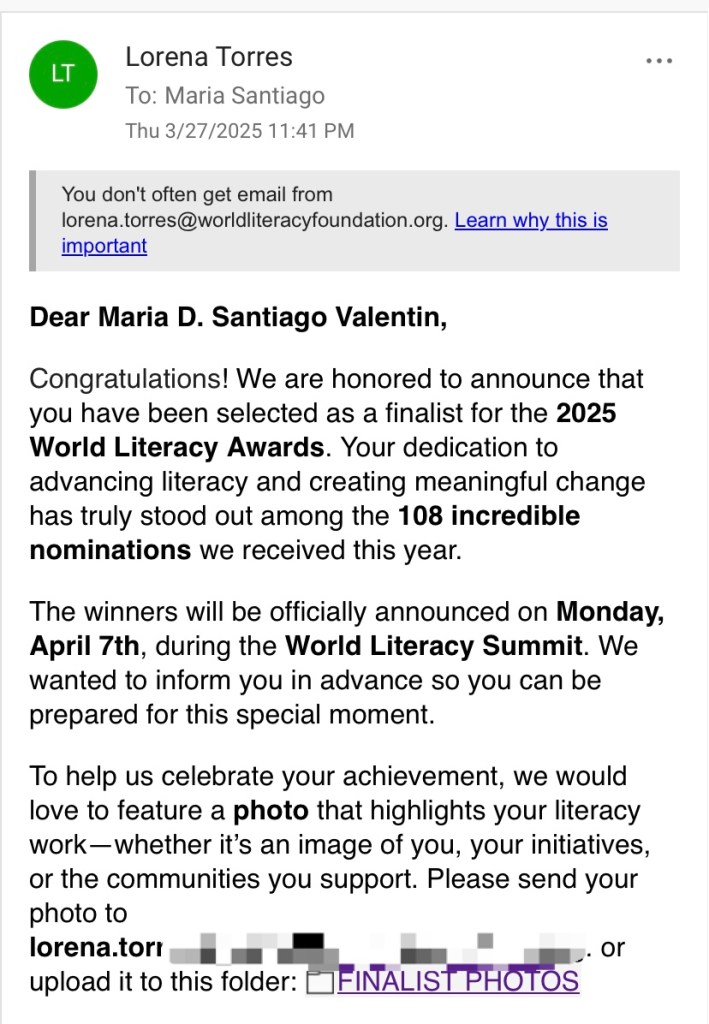
I am deeply honored to share that my doctoral research has been recognized under the category of Academic Research Recognition as one of the five finalists at the prestigious World Literacy Summit, standing out among 108 dissertations submitted from around the globe. This recognition not only highlights the significance of my work but also underscores the importance of advancing literacy within Career and Technical Education (CTE) as a means to drive social change, break cycles of poverty, and promote socioeconomic mobility.

The World Literacy Summit: A Global Platform for Literacy Advocacy

The World Literacy Summit, held biannually at Oxford University, is a globally renowned event that brings together literacy leaders, policymakers, researchers, and educators from over 85 countries. The summit serves as a platform to advocate for literacy as a cornerstone of sustainable development and social equity. It features diverse presentations on topics such as early childhood literacy, digital literacy, and literacy’s role in addressing gender inequality and community development,

This year’s summit was particularly special for me as I presented my doctoral study research tomorrow in Room 6 at the Examination Schools at Oxford University. My project study, which was completed as part of my doctoral capstone with Walden University in 2023, delves into how integrating literacy into CTE programs can empower individuals to overcome socioeconomic barriers. It is available for public access online.

The Impact of Literacy in Career and Technical Education

My research focuses on the intersection of literacy and CTE, emphasizing how embedding reading and writing skills into technical education equips students with both academic and practical tools for success. CTE programs are uniquely positioned to enhance literacy because they combine rigorous academic content with hands-on training. This dual approach motivates students by connecting learning to real-world applications, making literacy more relevant and engaging. 

For example, students in CTE courses often engage with industry-specific texts, technical manuals, and trade publications. These materials not only improve their reading comprehension but also prepare them for workplace communication. Additionally, writing assignments such as project reports or business plans help develop critical thinking and organizational skills. By fostering these competencies, CTE programs contribute to breaking cycles of poverty by equipping students with skills that enhance employability and upward mobility. 

Literacy as a Catalyst for Social Change

Education has long been recognized as a powerful driver of social mobility. By cultivating both social and cultural capital, it enables individuals to access opportunities that were previously out of reach. My research highlights how literacy within CTE can serve as a bridge for individuals from disadvantaged backgrounds to enter well-paying careers, thereby disrupting intergenerational poverty.

Moreover, literacy empowers communities by fostering informed decision-making and active participation in societal development. In today’s digital age, where technological advancements are reshaping industries, digital literacy is particularly crucial. Ensuring equitable access to education and technology can further amplify the role of CTE in promoting social mobility.

Acknowledgment from Esteemed Scholars

Being selected as a finalist at the World Literacy Summit is an award in itself, given the caliber of judges evaluating the submissions. The panel was composed by distinguished professors from Oxford University. Their acknowledgment lends tremendous credibility to my work and inspires me to continue advocating for literacy-driven solutions to global challenges.

I would also like to extend my heartfelt congratulations to Dr. John Gabrieli, this year’s award winner. Dr. Gabrieli’s groundbreaking work at MIT and the McGovern Institute for Brain Research has significantly advanced our understanding of brain mechanisms related to cognition and learning disorders such as dyslexia. His contributions exemplify how research can transform lives by addressing critical issues in education and mental health.

Looking Ahead

After my presentation at Oxford University, I am filled with gratitude for this opportunity to share my findings on such an esteemed global stage. This recognition is not just a personal milestone but also a testament to the transformative power of education and literacy in creating pathways out of poverty.

I remain committed to advancing this mission through continued research and advocacy. Together with educators, policymakers, and community leaders worldwide, we can harness the potential of literacy to build a more equitable and inclusive society.

For those interested in exploring my work further, my doctoral capstone can be accessed online through Walden University’s repository, ProQuest, ERIC or Google Scholar.

Screenshot